Tuesday, August 12, 2008

Summer


I lover summertime, and I love our front yard in the summertime. The three maple trees out front have flung out their leaves like so many sieves sifting the sun, green hands holding up the air. These trees provide shade over the grass until the early afternoon, and after a few hours the house shades the same spot, so it is cool and comfortable there; the grass is soft. The warm weather draws us outside; the shade keeps us there.

This summer has been about as fun a summer as I've had since I was a kid (probably, I'll never again have a summer as enjoyable as those I had between the ages of 4 and 12, because those days of freedom and discovery on the plateau lands in southwestern Colorado have set a very high standard). Part of it has to do with having a house and land and trees. The two summers previous to this one were spend in two different locations, neither with any trees nearby. I felt stifled and dried out. But now we can walk outside, walk barefoot through the grass and weeds, spend time in the shade, lie back on the ground.

Besides the house, the land, and the trees, I savor the summer because I don't work. I wake up with Elizabeth and the kids, we spend most of the day together, we put the kids down for bed, and the Elizabeth and I have a few hours to ourselves; sometimes we do something together, sometimes we do things in isolation, but the evenings provide a nice rejuvenating buffer between one day and the next.

Here are some of the things I've enjoyed most this summer:

teaching Sonora to ride her bike on the basketball court at the nearby park (she still has training wheels on, but at least she can pedal reasonably well)

picking vegetables from our garden with Sonora

walking through the yard while holding Rowyn (she likes being outside and seems to listen intently to all the sounds

watching Sonora walk around with her watering pail and water random plants (she even made a couple of flowers grow and then blossom in a planter we thought had nothing in it)

going on walks as a family

jogging every morning with Elizabeth and the kids

traveling to see family

eating breakfast, lunch, or dinner outside on the porch or the patio or the lawn

Wednesday, August 06, 2008

Dressing my Baby

When I lay her down on the changing table, she looks contentedly at me. I wonder, and a sense of guilt pervades the question: Do I ever pay as much attention to you as when I change your clothes? Do I ever focus just on you, just on you? She kicks and squeals and slobbers as I pull her arms out of the sleeves of her shirt. After I peel the tight neck of her shirt up over her face, she blinks, looks up at me with squinted eyes as if to ask: "Is it over? Will you be scraping anything else over my face?" Or maybe, "Did something just change?"

She is always excited to have her diaper off. I wipe her legs, her genitals, her back with a soft, warm, damp cloth, and she relaxes. The new diaper I fold in half and wave above her like a fan to dry her off so that for a short while, until she wets herself again, she will be totally dry. She shivers as the wetness evaporates and cools her skin, she pulls her arms, bent like chicken wings, in against her chest, goose bumps raise up across her skin. When I put the diaper under her back and snap it closed around her legs, I am amazed at the size of her thighs, round and fat, a fat-wrinkle roll halfway between her hip and her knee curving in an arc most of the way around. All this mass, all this body, that mind, that head, those legs, those fingers, those eyes, simply from the time she spent in the womb and now spends at her mother's breast.

After I pull her pants on, up her legs, past her clammy, flex-toed feet, I wait to put her shirt on. I run my fingers lightly over her belly, her arms, her back. She relaxes again, coos lightly, drops drool over her chin. Her skin is smooth like well-kneaded, half-risen bread dough. She feels my touch. I hope she knows I love her. When I put her shirt on, I have to pull her arms away from her body again to get them through her sleeves. She resists, so I give her a finger to hold onto and that makes it easier for her. Again, when the neck of the shirt is drawn across her face, she blinks, looks around uncertainly, wonders, perhaps, if the world is new again.

With her shirt on, she is mostly dressed, but I hesitate to put on her socks and instead I take each ankle between my forefinger and middle finger and begin tapping with my thumbs on the bare soles of her feet--left, right, left, right, left, right, left, right--while I quietly sing her a song to the rhythm of the tapping. I do not sing well, but I hope that, as her mind grows, this triangulation of left-sound-right will help her understand things, will later help her process the difficult things, the awful truths, the deep frustrations, that will come her way in the future when she reaches adulthood and realizes the confusion doesn't leave with adolescence. Maybe I can help her develop a strong corpus collosum. Maybe I can give her some advantage in life. Maybe something I do will make a difference.

Is this a father's blessing?

And then I push her feet into the socks, straighten the stretchy fabric into place, and give her to her mom. As I watch her cuddle the side of her cheek into that comfortable space between shoulder and neck, I know I have just experienced life.

Monday, August 04, 2008

Salami Picnic

Sonora enjoys processed meats--lunch meat, hot dogs, pepperoni, jerky, etc.--so when she expressed reluctance at the idea of riding in the trailer behind me when I went for a bike ride today, I knew how to make her excited about the trip. "We can stop for a picnic on the way and eat some salami," I said, and then she was interested. I really should have prepared a better lunch, but I was in a hurry, so I just grabbed the herb-coated salami and some nectarines and we hit the road.
The route we took wound out of our little town, followed a creek for a few miles, wound through wheat fields for a few miles, then through a small pine forest, then through more wheat fields and then back home. All of the roads are gravel, which made for a pretty slow pace (the trailer felt like an anchor at times).

Along the way, Sonora would point things out to me, and I to her. She thought the town's sewage lagoons were little lakes and I didn't have the heart to correct her. She has developed a fascination with grain silos and wanted me to look at each one we passed. I called her attention to the red-tailed hawk that was screaming at us shrilly from above as she circled the tree her nesting chicks were in. I also pointed out the small grove of trees that stood out like an island in the swaying sea of almost-ripe wheat. In the grove is a picnic table. That's where we stopped for lunch.

Sonora had brought the salami (she wanted to carry it in her purse), but I had left the nectarines in the garage, along with the knife that was supposed to cut the fruit and the chub of salted meat. So we had a lunch of salami and water. Sans any utensils, we just took turns biting into the thing. It was kind of fun, but sort of gross, too; it is awful-looking stuff. After our meal, I picked a head of wheat and dug out a few kernels. They were soft and green. When I bit into one, it was juicy and sweet with a hint milkiness somewhere between coconut and soy milk. As I dug more out, Sonora ate them faster than I could get them to her. "I like sweet wheat," she said.

The rest of the ride went more slowly and was kind of hot. It was still mostly enjoyable for me, but Sonora was bored and tired of bouncing around on the washboard (when we reached a short stretch of pavement, she said, "Dad, let's stay on this road, okay?"). When we got home, we tore into the nectarines; the salami hadn't been particularly refreshing.


About a week ago, just after some random fellow resident slowed down her car to briefly chat with us while Elizabeth and I were jogging, I told Elizabeth I think we are small-town people. She immediately agreed. We jogged over a small bridge that spans a gap through which the stream meanders that Sonora and I followed on our ride. That ride confirmed what I told Elizabeth: I like the country. It's not that cities don't have a lot to offer (I told Elizabeth yesterday that I wouldn't mind living in New York City for a couple of years), but they don't have wheat fields and hawk nests and old silos and gravel roads, and sweet, almost-ripe wheat. Perhaps I'll feel differently tomorrow, but today I liked what I saw.

Monday, July 28, 2008

The Ethics of Hunting

I had an epiphany the other day, and this is how I arrived at it: We are growing a garden, which is an excellent, environmentally sound way to procure food. But, even though it is rewarding--Sonora and I poke around the garden every day and take note of the most minor of changes--it still has a minor negative impact because we use city water to water it. City water takes electricity to refine and to pump; electricity is generated using coal or radioactive material, both of which have unhealthy side effects, and so forth and so on. Wild plants, however, grow from rainwater and require no electrically-powered pump to water and no fossil fuels to run a tractor to plant their seeds. So, I realized, if we could live from wild plants that we collected on foot within walking distance of our house, we could live without much of a negative impact environmentally. This is unrealistic, of course, for many reasons, but I liked the idea and pursued it further.

What about meat? was my next thought.

For a brief moment following this question, I had an image of plucking chunks of meat from raspberry bushes, which is also unrealistic, but then it hit me: hunting is harvesting wild meat. This elementary realization shocked me because I had long ago written off hunting.

I used to go deer hunting in Colorado with my brothers and my dad when I was a kid. We weren't one of those die-hard hunting families with 50 different rifles and extra chest freezers just to hold the three elk we'd "bagged;" if they were lucky (and a deer unlucky), one of the males in the family would kill and bring home one deer a year. They would gut it out and bring the carcass home and hang it up-side-down in a tree to age for a few days in the cold October air. They would slit the skin around its ankles and pull down, as if trying to pull a blanket away from a reluctant child, carving with a knife the white membranes that held the skin to the muscle; the sound it would make was similar to the sound of pulling plastic wrap off a bowl. Then we would bring large chunks of meat and bone, sawed from the main body, into the house, where this animal flesh would bleed onto the kitchen table as it was chopped into steaks and roasts and jerky strips.

It was all pretty gruesome and the house smelled gamy for weeks. I didn't ever like the process very much, nor did the sagebrush-fed meat taste very good to me (I did like the jerky). When I went hunting with my dad or my brothers, I never shot a deer; I don't even remember pointing a rifle at one, but I observed because I thought the knowledge might be important some day. That is, until the last hunting experience I had with my dad.

He shot a doe. It was an easy shot across an open field and she went down. But when we got to her, she wasn't dead and my dad had to finish her off. He took out his knife and approached her, and she stared at him calmly as he approached. Her dark, round, moist eyes peered at him, perhaps at his soul. He straddled the does neck and then plunged the knife through her throat, severing her arteries and opening her esophagus. As she bled out, she stared at him until her eyes went dull.

My dad was silent and when I approached him, he turned his head away. He was crying. I could tell this, though I think he was ashamed. "I hate this part," he mumbled in explanation.

After that, I decided hunting was too painful, for the animal and for the hunter. I figured hunting must cause the hunter to become jaded, insensitive to death, insensitive to his or her own humanity.

The thing is, however, that every time we eat meat, we participate in the death and killing of an animal, of some cow or chicken or pig somewhere in the world that also has searching eyes. The difference is, we don't have to look at them. We get the plastic-wrapped bundle without having to hear the plastic-wrap sound of the skin being torn off. But isn't that jaded? Isn't that insensitive?

And there is the environmental factor to consider. Most meat sold in a grocery store (some co-ops excepting) has been grain-fed--highly inefficient--and given a steady regimen of antibiotics and hormones on a feedlot in the U.S. or New Zealand or somewhere else, shipped to a slaughterhouse, cut up, shipped to a packing plant, packaged, shipped to a grocery store, purchased, and shipped home to a refrigerator. A lot of energy has been wasted on this roast.

A deer or elk feeds on wild, organically-grown plants (unless the animal gets into a farmer's fertilized, insecticized, herbicized crops), lives a relatively fulfilling life, and then it is shot by a hunter; she or he will have to see the animal whose life has just seeped out of it. Unless this hunter is a trophy hunter (a despicable thing, trophy hunting), the hunter will know what she or he is eating and that it cost a life; this person can not hide behind the ignorant screen of cellophane and Styrofoam that suggests that meat costs only money.

There is the economic benefit of hunting as well: $50 or so will buy a license. An adult deer would yield somewhere between 50 and 120 pounds of meat, an elk a lot more. Of course, to have the full savings, instead of taking the carcass to a meat packing plant, you've got to skin it and butcher it yourself, which is messy and time consuming but valuable in that the family knows they are eating an animal that is dead and bleeding on their table because of them.

The thing is, though, that hunting is highly unappealing to me. I hate killing things, even insects. I've forgotten most of what I learned as a boy about gutting and skinning and butchering and packaging. But the more I think about it, the more convinced I become that hunting is more morally correct than consuming meat purchased at the grocery store. I am becoming convinced that I have two choices: hunting or becoming vegetarian. Elizabeth and I were vegetarians before for a few years and it was difficult to give up meat, but it might be easier than buying and using a rifle.

What do you think? Is hunting more ethical, more moral than just buying meat at a store, or is this recent mode of thought misguided?

Tuesday, July 22, 2008

Death of the Family Vacation?


So a few weeks ago, while we were on vacation in Utah, Elizabeth and I heard a blurb about an upcoming story on NPR about the passing of the "Golden Age of the family vacation," as if family vacations are now dead or at least past their prime. We were going to meet a friend at a park in Salt Lake City, so we didn't get to hear the story, but here is what I think they were going to say: Disneyland, airplanes, in-car DVD players, and high gas prices have killed the great American family roadtrip. Maybe they said nothing of the sort, but I'm going to proceed on the assumption that this was the premise of their story.

Of course, I'm not sure I know what a great American family vacation looks like. Here is my image: the family, packed into a car with stuff strapped to the roof, driving to some National Park, or along a historic route, or to see family members who live far away; along the way, the parents lead the children in all manner of time-consuming games to keep the kids from fighting and whining: playing I spy; singing show tunes and children's songs; passing out books and puzzles and yarn; etc. Most of these activities work only for a short while and then the kids are fighting and Dad is yelling and threatening to turn the car around and go home--a stupid threat, even he knows this, but it is tradition and an easy thing to say when he is angry. Through the road trip, the kids get to know their country more fully, bond with their family, and receive mental bookmarks to place in their memories as they become self-actualized.

I am certainly glad for some of the trips we went on when I was a kid. Mind you, we were poor and my experiences reflect this. Some of the experiences I remember were not necessarily pleasant, but I'm still glad for them. Here are a few that stand out in my mind right now:

I don't remember where we were going or how old I was (young), but I remember mountains of snow on either side of the car. We stopped and got out. The road was at the bottom of a seven-foot deep white canyon. The day was fairly warm and the snow was densely packed and taller than both my parents. My dad lifted each of us kids individually up onto the towering snow. Somehow this unexpected snowy encounter became a main attraction in the trip, something we talked about as much as whatever it was we were originally going to see.

On another trip, the family was driving during the summer to some desert location. We traveled in my dad's beat up 1965 baby blue Ford truck. My parents and the baby sat up in the front bench seat. The rest of us rode in the bed of the truck, protected from the wind by a camper shell. On this trip, my parents had left us a case of Shasta soda to quench our thirst, but we worked our way quickly through it and we were beginning to get thirsty again. I also needed to pee. We banged on the window to let my parents know they needed to stop, but they had had enough stopping on behalf of whiny kids (with seven kids, it must have seemed as though every twenty minutes one or the other of the children needed to stop). When I got no response from my parents, my older brother, Clinton, suggested I just pee in one of the empty soda cans, which I did with great relief. When I was finished, I decided to dump my urine out the window. But Dumoan, my oldest brother, grabbed the can from me. He was thirsty and didn't want me wasting the remainder of a soda; apparently he hadn't seen me quietly relieving myself in the corner. I started to tell him that that warm fluid in there was not soda pop, but Clinton shook his head as if to say: "Let's just see what happens." Dumoan took a deep draft of the warm, salty hint-of-ammonia Shasta and then spit it out in horror. Clinton was laughing heartily while I chuckled in disbelief. Dumoan punished us both that day; he failed to see the humor that kept us laughing even while being pounded with fists.

In that same blue truck, we took a trip to a couple of the National Parks in southern Utah. Zion NP stands out in my mind, mostly because it seemed somehow otherworldly, exotic, pre-historic. I remember water falls and trees and weird rock formations. I also remember a shirtless man whose entire torso and arms were covered in tattoos. He was a hairy, tan, big-bellied man and I hiked close behind him, trying to untangle all those images from each other. I had seen tattoos before, but never in this quantity; they were like cave paintings: stories that couldn't begin to tell themselves to me but held some meaning anyway, overlapping stories, some grotesque, some beautiful, some scary, others comforting. All kinds of human emotions wrapped up in ink impregnated in a fat man's skin.

When I was eleven or so, we took a trip to Vegas and stayed in a hotel, an unusual treat for us. My parents, being frugal, chose the cheapest hotel they could find. The whole family slept in a single room with one queen-sized bed. Most of us were strewn out on the dirty carpet, using a pair of pants or a couple of shirts for pillows. Our poor sleep that night, however, was not due to physical discomfort, but rather to the rhythmic knocking of our fellow patrons next door. My parents are fairly sure our neighbor was a prostitute with a customer. They were annoyed and embarrassed to have all their kids hear that display. I can't say for sure what the profession was of the person next door, but I do know I was intrigued by the whole thing.

In southeastern New Mexico, I saw my first cockroach; it was crawling up the shower wall in another inexpensive hotel the whole family slept in. We were on our way from Colorado to Texas. Somehow seeing the cockroach was validating. I had seen thousands of commercials for cockroach killing chemicals and contraptions, but never seen the actual creature that caused Americans to spend millions of dollars to control them. On that trip, I knew we had gone somewhere.

For spring break when I was fourteen, we went to St. George, Utah to visit my maternal grandma. We didn't know that St. George was a spring break Mecca for college and high school students. We went to "the narrows" above the town to shimmy our way up a long crack in the sandstone. It was fun, but what I enjoyed most were the hundreds of physically mature girls sunning themselves in swimsuits on the rocks. I had never seen anything like it.

When I was eighteen, I took a trip with my dad. Since it was just the two of us, I don't know if it qualifies as a family vacation, but it had the feeling of one. This time, however, I did most of the driving while he sat in the passenger's seat. We didn't sing songs or play games. We talked, like we had never talked before. We talked about relationships and love and sex and religion and sorrow and life. When we spoke, I noticed he did not hold back in the discussion; his words and ideas were not sanitized and carefully chosen. They were honest. Our relationship was not like the father and son relationship I had become used to; we were now peers. I was now an adult, and that was the first time I had felt like one.


On this most recent family trip Elizabeth, Sonora, Rowyn and I took, we visited friends in Boise, spent time with Elizabeth's family in Utah, I went backpacking with Clinton, we went camping, to the Lagoon amusement park and to family reunions in Blanding and Logan, Utah. It felt like a family vacation: I snapped at Sonora a couple of times; we stopped occasionally to feed Rowyn or change her diaper. Sonora helped entertain Rowyn, sang songs with us, started learning to play "I spy," and spent lots of time playing with her cousins. She also participated in paper boat races, rode a horse, rode a roller coaster, picked peas and raspberries, learned to fly a kite, went to the dinosaur museum, and saw all of her grandparents. I wonder what, in 30 years, she will remember from this trip.


I certainly hope the family vacation is not dead; if it were, I think we as a nation would be poorer for it. Family vacations provide rare moments in time by which we can gauge the progression of our lives, our development as individuals and as part of a family unit.

Saturday, June 28, 2008

Distant Canyons


I've long felt a sort of mystic connection to Native America, mostly because of where I grew up, my parents, and because of my religion, which sees a connection between ancient Israel and ancient America. The little town I grew up in is surrounded by Ute land, and to the south is the Navajo Indian Reservation. And beyond the Utes and the Navajo in time are the Anasazi, or the Ancestral Puebloans. I have many memories of investigating ruined mesa-top pueblos and sandstone cliff dwellings. Long before my ancestors left Europe, these people lived on the land I grew up on. My parents have also long been interested in Native American cultures: my mom collected Navajo rugs and Hopi Kachina dolls; my dad collected arrowheads and pottery shards. I have worked at a couple of places whose identity relies heavily on indigenous culture: The Anasazi Foundation and Mesa Verde National Park. So last winter when my brother Clinton and I began planning a trip to the Canyons of the Ancients National Monument, I felt as though I was preparing for a sort of communion, a return to a part of my spiritual and existential core. The reality, however, turned out to be less romantic. The trip was much shorter than anticipated and made me embarrasingly aware of my distance from the long-dead people I feel a kinship with.

Clinton and I hit the trail last Saturday morning. We started hiking around noon, which was a few hours later than we had hoped to start, but it still left us enough time to get to the spot we had decided would be our destination that day. We began hiking down Sand Canyon trail and were enjoying the slight downhill grade of the trail. Along the way, I pointed out things I had learned from my time at the Anasazi Foundation: which plants make good bow and drill fire sets, which plants are edible, what barks make good tinder. Clinton knew much of this already, but I told him anyway because I was excited to be in the desert again. We were both confident and excited for the challenge and the adventure.

We had prepared well for the trip. We were both in reasonably good shape; we had enough food to easily last seven days; we had a tent, sleeping bags, a stove, a water filter and everything else we would need. We knew from the planning phase onward that the biggest challenge to the trip would be the lack of water. In the summer, none of the streams in the monument run. But from several experiences in Arizona digging in dry creek beds and finding water, and from learning at Mesa Verde that Ancestral Puebloans almost always built their cliff dwellings next to a seep spring, I was sure that I could find water. Still, as the day grew to be very hot, and our 70 pound packs weighed down on us and as the warning of the ranger at the Anasazi Heritage Center ("I don't think there is any water out there") continued to echo through my mind, I became a little less confident.
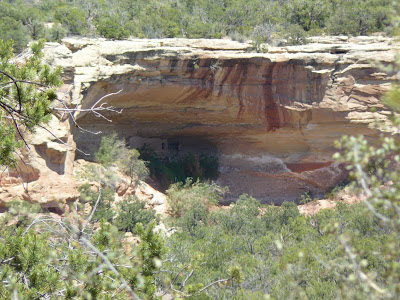
Most of the first few cliff dwellings we saw were not dwellings at all, but were probably grain storage buildings. There were no reliable sources of water near these that we could find. We did find one dwelling that had obviously been built to be lived in and after poking around a nearby shallow alcove, I found a seep spring. It was not flowing, but the soft sandstone was wet to the touch and could have yielded water with a little effort. Finding some indication of water bolstered my spirits somewhat and we hiked on.

Besides water, another major challenge in to our undertaking was the terrain. The topographical map I was using, I came to realize, used meters instead of feet to show elevation changes, and it was of a scale I wasn't used to. What this amounted to was canyons that were deeper and plateaus that were much higher and more rugged than I had anticipated. Most of our planned route followed no trails; instead we hoped to climb out of one canyon, over a plateau, and into another canyon day after day. The extreme scope of what we had planned began to dawn on us as we sank deeper into our first canyon.

At first, we took several pictures of ruins we noticed in the sides of the canyons, but as we grew more an more tired and as our water supplies diminished, we would simply glance at at a ruin and then continue on, not bothering to take out the camera and document it. That afternoon, when we realized we were not going to make it to the point we had originally intended to reach, we picked a place on the map where two creek beds merged and where I thought we could find water. We climbed over a plateau at a low point and into a sandy creek bed. By this time, we were rationing the little bit of water we had left. We stopped at small grove of cottonwood trees and I took out the small spade Clinton had brought with him and began digging in the sand to look for water. After digging about eight inches down and encountering only dry sand, I decided to hike farther downstream. I left my pack with Clinton (he was trying to rest in the shade, but the deer gnats hounded him until he gave up), and walked about a mile and a half down the creek bed. I stopped at several promising spots and dug a hole a few inches deep with the toe of my boot, but never found any hint of moisture. Finally, when I was much farther from my brother than I had intended to be, I heard water running.

I walked toward the sound of the water and had to cross onto private land to get to it, but I found a little oasis--a large, fast-flowing stream. It didn't look like a natural stream, more a product of irrigation, but it was wet and I was excited. We camped that night under an old cottonwood tree a few hundred yards away from the source of water. That night was enjoyable. We stretched our tired backs, boiled water to poor into our freeze-dried meals, talked about the hike, what we had seen and gone through, discussed our families, and talked about life. We were glad to be alive and felt somehow victorious, as if we had defeated nature. From where we were camped, we had cell phone reception and he called Mandy and I called Elizabeth, to let our wives know we were alive, we had found water.

The next morning, we got an earlier start, though after filling up with water, our first task was to climb up the east-facing side of a plateau. The sun reflected off the rocks and the heat was astonishing even at nine in the morning. Toward the top, after we had scrambled and climbed for most of the morning, I began to feel nauseas. I'm not sure why I was feeling sick, but I quickly lost energy as well and began lagging and wanting to take long breaks. I few times I dry heaved and wished I could just vomit and get it over with. I thought maybe the nausea came on because of the ibuprofen I took that morning to help with the soreness I felt all over, but I was also afraid my body was dehydrated. After we had sat in the shade for about half an hour waiting, without success, for me to recover, Clinton half-jokingly offered me a sprig of Mormon Tea. I chewed on the thin, green eight-inch stick for a moment and then stood up and we started hiking. After about five minutes, my nausea was completely gone and ten minutes after that, my energy level was back to normal.

We hiked at a brisk pace across the top of the plateau and continued on until we hit an old 4x4 road, which we followed farther to the northwest. That day, we were headed for a spring that was somewhere in about the middle of the Monument. We thought if we could find a reliable source of water, we could set up a base camp there and do dayhikes to areas that looked interesting. When we dropped back into a shallow canyon and hiked on top of another plateau, we got to the canyon I thought should contain our spring. We dropped off the side of the plateau, bushwacking our way down through juniper and pinion trees and brush. We hiked downstream for about a mile to where I thought the spring should be. We got there and found nothing. By this time we were tired and we each had maybe two cups of water left. The day was very hot again, and we were losing a lot of water through sweat and through breathing. We walked a little farther downstream to where we had a good vantage point of the lower canyon. We could see a little clump of cottonwood trees among the darker pinion/juniper trees and we decided to head for the cottonwoods. That must be where the spring is.

I think we both knew there would be no spring there, that we would find only dry sand just as we had done every time before when we used cottonwoods as our guides. And besides, the canyon opened up considerably where those cottonwoods were; it was more of a valley than a canyon at that point--not the sort of terrain that produces a spring in a desert. However, we went for it, hoping we would find water. Just as our intuition told us, the creek bed was a dry downstream as it had been above. We dropped down for a rest beneath what would be a waterfall if there had been water. I took out the little hand-sized shovel Clinton had brought and began digging in the sand. It kept collapsing on me, but I kept digging anyway. This, I knew, would be a moment of decision.

I dug the little well about one-and-a-half feet deep, until I hit the sandstone bottom and could dig no more. The sand and rocks were moist, but no water came seeping into the hole, not even a little water pooled in the bottom. In fact, every minute I waited, I notice the damp sand that lined the walls of the well becoming dry as the heat and thirsty air quickly wicked away the moisture in the earth. That is when I knew we were done. To continue on would be stupid. By continuing on, trying to find the elusive spring, we had already put several more miles between ourselves and our cars.

Hiking back out of that canyon was tedious and tiring. We had decided to head for the cars and go camping instead in the mountains near a river, where we would lie back in its cool waters and be refreshed in its clear abundance. But the cars proved elusive. We followed Clinton's GPS, which he had used to mark where the cars were. As the crow flies, it placed us only a few miles from the cars, but as the hiker walks, we were several times that distance away. We climbed and staggered until we ran out of water. Clinton began to get nauseas, and his nausea was definitely a result of dehydration. He had urinated only one time since we started the trip a day and a half earlier. His muscles were beginning to cramp. Both of us were tired, almost unnaturally tired. We stopped in a little patch of shade. I could tell that Clinton wasn't going to be able to continue much longer.
After we rested for a few minutes, I suggested I leave my pack with him and that I take the GPS, find the cars, and bring my car back and pick him up. We had been following a 4x4 trail for a while and I thought I might be able to get the car back to him. He agreed to my suggestion without reservation. He held out to me his Nalgene bottle. It had maybe a fourth of a cup of water in it. "Take this with you, man," he said. I protested. He needed it more than me. He shook his head, "Just take it. You'll be walking; I'll be sitting here. You need it." I took the orange bottle and his GPS and set out. The GPS said I had 1.9 miles to go, but it ended up taking me five miles to get to the cars, as I had to follow a road of some sort so that I would know how to get the car back to my brother. Strangely, as I was hiking, I did not feel tired or thirsty. I maintained a pace of about 4 miles per hour and found my way back to my car.

I was only able to get my car to within about 3/4 of a mile of Clinton. The road became impassible, but I brought him some water I had left in the car and we hiked out alright. That night, when we finally got out of the Canyons of the Ancients, we didn't go to the mountains to bathe in a river. Instead, we headed for a hotel in Cortez, a hotel with beds and running water. I told Clinton I felt like the land chewed us up and spit us out. "That was rough. That was rough," we kept telling each other; that was rough.

The thing that kept coming to my mind, still keeps coming to my mind, is that thousands of people lived where we could not survive for two days. Tree ring data taken from logs used in Ancestral Puebloan dwellings suggest that the climate 1,000 years ago was not much different than it is today (it has gotten a little warmer and a little dryer). That means there was only about as much water then as there is today. But they survived, they built rock homes with square walls and multiple stories. They built large, round, deep ceremonial spaces using only sticks and rocks. They made pottery and painted intricate designs on it. They created art.

When I realized these things, I realized I am not as close to these ancient desert dwellers as I had previously assumed. We grew up on the same land, but I grew up with electricity, with factory-made clothing and footwear, with a well dug by a machine, in a house built out of lumber made of trees hewn hundreds of miles from where they would be nailed together into a structure.

I'm glad we went; I enjoyed spending time with my brother, and I am glad for the reminder of the immense cultural structure we take for granted but which keeps us from dying. But I feel a little more removed from the ancient people who played a part in constructing the mystique of my childhood. We aren't as alike as I had previously thought.

Thursday, June 12, 2008

Mountain Song

In just under a week, we are going to leave for Utah and Colorado. Elizabeth is going to Utah and I'm going to Colorado. My brother and I plan to go on a 6.5 day, 90 mile backpacking trip around and through the Canyons of the Ancient National Monument. In preparation for this trip, I've been half-heartedly training by riding my bike to and from work and donning my backpack.

When Elizabeth's sister Carrie and her son Asher came to visit, we took a short trip to one of the only mountain-like features in the area: Kamiak Butte. A 4-mile trail climbs the butte, follows along its crest, and then drops back down to the parking lot. I decided to carry Sonora in our kid backpack and hike the trail quickly to get into shape. Elizabeth carried Rowyn in a baby sling thing, and Carrie pushed Asher in a jogger.

The thing that always surprises when I visit the butte is how much it feels like wilderness. In reality, it is little more than a large, wooded bump that rises 1,300 feet above the surrounding rolling fields. But once the trees surround me and my feet hit the loamy earth and the musky air fills my lungs, I feel as if I am in a mountain range.

On this occasion, I was trying my best not to be distracted by my surroundings. Kamiak Butte was a great place to train for a backpacking trip, sort of an outdoor gym. But as we reached the top of the the first ascent, Sonora said "This mountain sings a pretty song." Her words stopped me.

When I asked her what she meant, she did not elaborate, but I knew what she meant, and I am immensely grateful she hears that song. I stopped then to listen, to feel, for myself, as I should have done earlier. "Should we wait for Mom and Carrie?" I asked. Sonora said we should, and we did. The hike was slower after that, but more enjoyable. When we reached a downed log, Sonora asked to walk on it, so I took her out of the backpack and she scampered around on the log, which is something I always liked doing, still like doing, when I am in a forest. She walked the rest of the hike.

When we came to a fork in the trail, we decided to go up to the summit. Sonora and Asher climbed up the trail to the top. They proceeded with gusto; they didn't know that reaching a summit is often significant to people, but they seemed driven to ascend. At the summit, they climbed onto and jumped from small boulders and we all stared for a moment at the falling, fiery sun. We returned to the cars just after dark.

At two months old, Rowyn is too young to let us know of her recreational likes and dislikes, but Sonora has definitely indicated a love of nature, and that brings me deep satisfaction. Part of me wonders why I care whether or not my daughters like to be outside. They have their own personalities; they will inevitably have likes and dislikes different from mine, but this one matters a lot to me. I think it has something to do with my perception of wholesomeness and fulfillment. Hearing a mountain sing seems to me to be akin to feeling life, to tasting beauty, to embracing kindness, to hearing God. I want my girls to know that, even though they move about freely, they are planted in their planet, they are a part of it: the dirt under their fingernails and between their toes is the dirt that grows their food and holds up the tree that cradles the robin's nest; it is the dirt that holds their house up, that will be the receptacle of memories, will harbor the imprint of their tender feet, so that when they return to that place in many years, the dirt will enshroud them in memories of running and planting and playing and singing and will say softly, over and over, "you were here, you were here, you were alive, you are rooted."